Rising Energy Prices Persist As Federal Interventions Fall Short

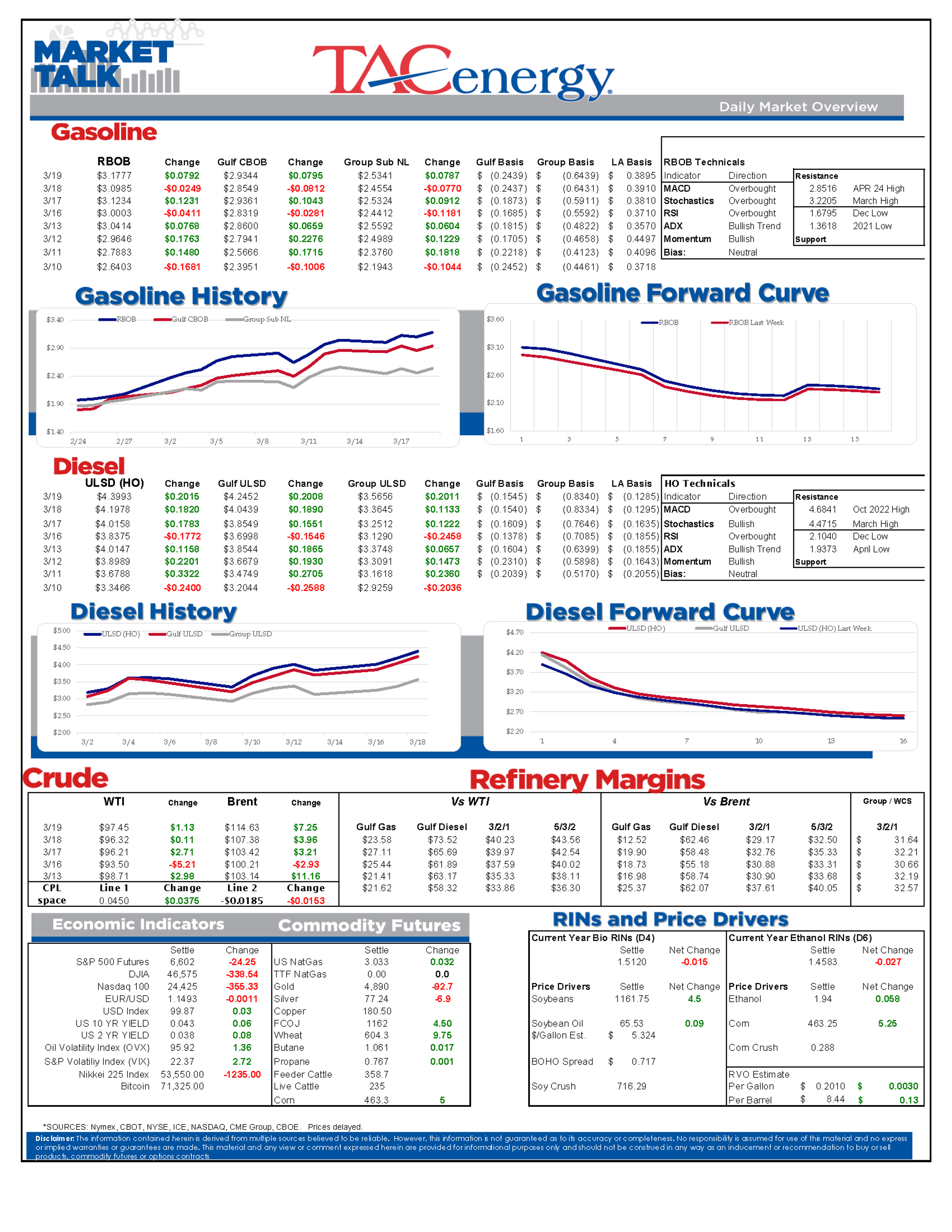
The energy complex is moving higher again this morning with Brent crude oil leading the way, trading $7 per barrel higher prior to the formal Thursday open. NYMEX HO is following close behind, adding nearly 22 cents to its prompt month contract price, while gasoline futures trade around 7 cents over yesterday’s settlement. WTI crude briefly breached the $100 mark in overnight trading and has since pulled back to the $97-$98 level.
The White House released a couple more safety valves yesterday in an attempt to reign in energy prices.
The Administration has waived the Jones Act for the next 60 days, opening up shipping between U.S. ports to non-U.S. flagged ships, hoping that the loosening of this artificial logistical bottleneck will help bring down retail gas prices. The effort faces two critical roadblocks:
1) Foreign flagged vessels are currently priced at parity with, or at a premium to, U.S. flagged ships, due to the disruption in the Persian Gulf, which eliminates the financial benefit of shipping with a non-Jones Act boat.
2) The U.S. refineries, by-and-large, are set up to process heavy-sour crude typically sourced from Canada, South America, and the Middle East, which already gets delivered by a foreign flagged vessel. Waiving the Act opens up the ability to ship our domestic light-sweet crude to domestic refineries that aren’t tuned to refine it.
Later yesterday afternoon, the U.S. Treasury announced it would be easing sanctions on PDVSA, Venezuela’s state-owned oil and gas company, allowing U.S. companies to transact with it while retaining control of the cash flow. While this may offer long term benefits (or detriments, depending on who you ask) for the Venezuelan energy industry, it will make little impact on replacing the 16 million barrels per day stuck behind the Strait of Hormuz.
The story so far: releasing barrels from the SPR, offering maritime insurance, trying to form a security team, and pausing sanctions on Russia and India have all failed to temper energy futures’ meteoric rise in prices.
From the DOE report:
Crude built across all PADDs, despite exports surging from the lowest value of the year to their highest while U.S. demand lifted higher. However, imports also shot up to a 2026 high and the swing in the crude adjustment added 7.5 million barrels to the balance.
While rates declined in all other PADDs, total U.S. refinery runs increased slightly due to PADD 3’s Valero Houston and Exxon Baytown facilities resuming planned rates following unit maintenance, adding back 265 mb/day. In PADD 2, Citgo’s Lemont refinery shut their only catcracker and an alkylation unit for planned overhauls expected to last around 45 days.
Diesel stocks fell again with demand moving to the high end of its 5-year range. Most regions are around average levels outside of PADDs 1 & 3. PADD 1 has spent the last 6 weeks running under its 5-year range while PADD 3 has declined over the past 5 weeks, although it’s still about 3.5 million barrels above the 5-year average as storage levels have held well above normal since September last year.
Despite a pullback in demand, gasoline inventories slid for a 5th consecutive week as production tapered off while imports remained low and exports stayed high. Stock levels are still healthy across the country, outside of PADD 5, with all holding well above seasonal norms, even after PADD 1’s 3.5 million barrel drop last week. The decline in PADD 1 came entirely out of PADD 1C which includes East Coast states from Florida to West Virginia, most of which are Colonial Pipeline fed markets.
Latest Posts
Refinery Disruptions And Strait Closures Fuel Diesel Rally
Oil And Diesel Rally On Escalating Infrastructure Attacks
Energy Markets Pause After Historic Rally As Supply Risks Persist
$5 Diesel Now Feels Inevitable: ULSD Blasts Past March Highs, No Resistance in Sight
Week 36 - US DOE Inventory Recap
Brent Tops $100 As US Iran Tanker Strikes Escalate, While Gasoline Backwardation Is Deflating
Social Media
News & Views
View All
Refinery Disruptions And Strait Closures Fuel Diesel Rally
Oil And Diesel Rally On Escalating Infrastructure Attacks